The Problem with Putting a Price on Food
An Experiment in the Gift Economy by Hannah Breckbill

This column was reprinted from Hannah Breckbill’s Humble Hands Harvest Substack page.
A couple weeks ago I saw an interview of some of the members of People’s Plumbing, a worker-owned cooperative in Cleveland, who are operating in the gift economy. They’re practical workers who do plumbing projects, and they’re also acting on anti-capitalist values, offering their plumbing work in the spirit of the gift. They let their clients know what it costs to do the work, but they don’t have an expectation that they’ll pay that amount, or anything at all. Because, according to this worker-owned cooperative, everyone should have decent plumbing regardless of their ability to pay.
I listened to this with the mental equivalent of my jaw on the ground. I’ve been a student of the gift economy as well as commoning for a number of years, and it was astonishing to hear such practical language about a gift economy project that is working (as in, the workers are both receiving a decent income and accomplishing meaningful work). So often alternative economic ideas are treated as woo-woo, which makes it hard to take them seriously or believe that they can work under capitalism. But what really grabbed my attention was the insistence of these plumbers that everyone should have access to basic sanitation even if they don’t have money—because, in my mind, the same goes for food.
It’s complicated being a vegetable farmer. Lots of us got into this work wanting to feed people, and yet attaching a price to food is the equivalent of erecting a barrier around it. Of course, selling the food I grow allows me to make a living in a way that has a lot of beauty and integrity to it. But it has not felt right when people leave empty handed from my farmers market stand because the price I attached to my food is too high for them to justify.
Farmers—specifically direct-market food farmers—have a really hard time making a living. There’s so much investment required, of money and labor and guts, to start a farm business, and then we sell our produce a couple dollars at a time. We do the math on each crop and find that we barely break even, or we are actually losing money. As my co-farmer Emily says, if we’re not above break-even, “we are paying actual dollars for people to eat our food.”
My particular farm has made it work—we’ve tried to price our products so that there’s some profit, we’ve dropped crops from our plan when they don’t break even, and we’ve built up growing techniques and efficiencies over time. We also have sought out sources of income other than selling food, such as NRCS grants for our conservation practices, or stipends for hosting the Queer Farmer Convergence or doing on-farm research trials or participating in mentorship programs. These are essential in keeping us in the black every year—otherwise we would have to raise the prices on our food in order to stay afloat.
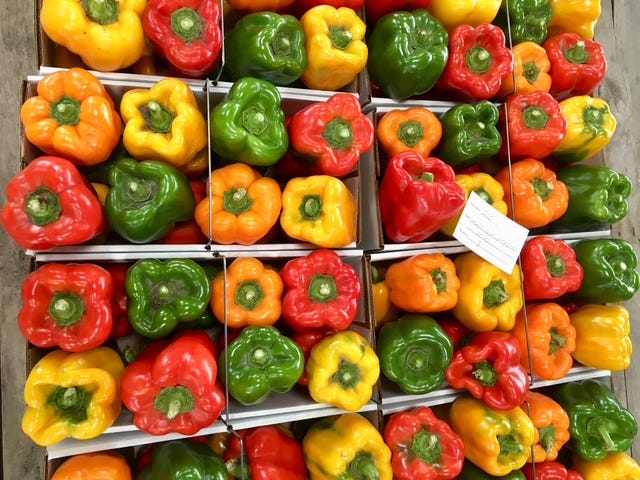
Market farmers have a lot of opinions about pricing. Mostly, undercutting is a big no-no. I used to be mad when I saw peppers at the market priced for a quarter each, compared to mine at $2. Lately, I’ve been more curious (and, I’ll admit, a little judgmental) when I see a farmer undercutting really significantly. I wonder if they’re losing as much money as I think they are, and why they’re willing to undervalue their work like that.
The other thing that can get a lot of farmers’ hackles up are nonprofit farms. They’re selling produce and sometimes even competing in the same markets as us, but their workers have salaries and benefits and so much less risk because their income isn’t reliant on their sales. It’s easy for a farm business owner to feel the unfairness of so much risk being on our shoulders. I’ll admit that as a young farmer focused on making my business work, I sometimes even had hard feelings about gardeners giving food away to their neighbors, thereby “undercutting” local farmers who are trying to make a living. I’m glad to be able to see the bigger picture these days.
I’ve been in conversations at farming conferences when the issue of affordability comes up. Someone asks a speaker, “OK, so you raise the most expensive chicken in North Carolina. How do you sleep at night knowing so few people can afford it?” Almost invariably, the speaker (sometimes I’m the speaker!) responds along the lines of, “I need to price my products so that I can pay myself. It’s not my responsibility as a farmer to fix the entire food system. My role is to grow good food and stay in business so that I can keep growing good food.”
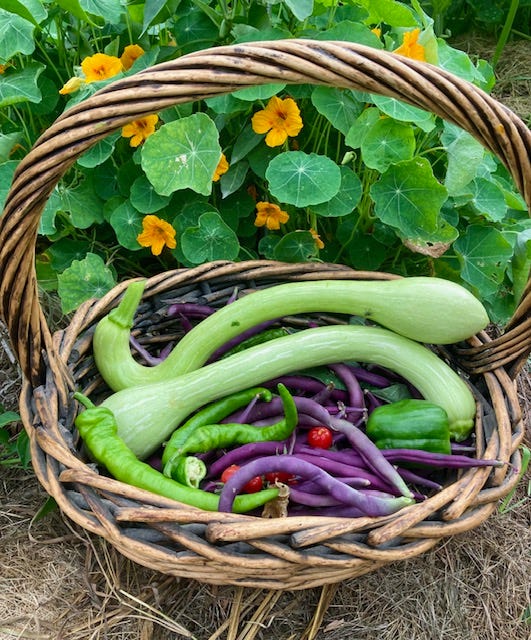
For the past few years at Humble Hands Harvest we’ve been working to bridge the gap between our prices and what’s affordable by leaning on our community. I might be adamant that it’s not a farmer’s responsibility to solve the problems of the food system, but as a CSA farm we do have the capacity to organize. We’ve offered “solidarity shares” to our CSA members, giving them an opportunity to add $25 or more to the price of their share so that we can donate that amount of food to people who need it, both directly and through the food pantry. We’ve had CSA members whose shares were subsidized by other members.
There was a period of time, 2022-2024, when there was federal funding (called the LFPA) to pay farmers a fair price to give food to food pantries. Since that funding was terminated by the Trump administration in early 2025 I’ve oriented our farm’s fundraising toward continuing some of the distributions that we had been making under the LFPA. And in 2025, I finally made a move toward giving large donations to our local food pantry without compensation other than a tax receipt.
As great as the food pantry is, though, it doesn’t cover all of the need. Plenty of people want to eat local vegetables, looking fresh and abundant on a farmers market stand, but can’t stomach the price for any number of reasons. I’ve started to realize over the past few years that I would rather have people eating and appreciating the food I grow than to get paid for it. Ideally, both would be possible, but if only one can, I would rather have my work feed people than a compost pile.
It took me a couple days to conceptualize and bring it up with Emily, but after learning about People’s Plumbing, we have decided to try out the gift economy at our farmers market stand. We’ll start attending Decorah Market on Wednesdays in June, and, while we’ll have our prices posted, we won’t turn anyone away if they can’t (or don’t want to) pay. We anticipate a lot of interesting conversations about it at our farmers market stand, but hopefully nobody gets too confused and everybody ends up with the food they want!
We grow food because we want to work with the land, to enjoy the beauty of plants, and to share food with our community. I feel the value of my work when people eat and appreciate the food that I grow—whether or not the farm gets paid for it. We need to receive money for our work in order to keep doing it, but just as it’s not every individual farmer’s responsibility to ensure food access for their community, it’s not every individual eater’s responsibility to ensure a farm’s viability. With the choice to try on the gift economy, we’re stepping into trust, acknowledging the many gifts we’ve been given, and delighting in the food that gives of itself with such generosity.
Humble Hands Harvest is a publication offered in the spirit of the gift. To receive new posts, become a free subscriber. To pass the gift back to Humble Hands Harvest, you are welcome to pay for your subscription!
Mary Swander’s Emerging Voices is pleased to be a member of the Iowa Writers Collaborative. Follow our Sunday Round-Up and Flipside editions to find compelling reading:
Wow! Thank you for raising these difficult questions and for sharing and daring some answers. Thank you for your work and for your love.
Very on target for what I think is coming next - a grass roots recover after the orange man dies or leaves the scene. There is no one who has the same level of control over people to take his place and it will be the farmers who willl lead the efforts to get things back under the control of real people. Hopefully, the medical field will then follow suit.
We WILL get there eventually. Perhaps after the 1% take off in spaceships and leave us to it.