Seeing Beyond Fences
by Jane Yoder-Short


Heads up: Mary Swander will be appearing on the Iowa Farmers Union “Lunch and Learn” Zoom series. She’ll speak on art and agriculture. Noon, CST, Thursday, February 19, 2026. Tune in: https://iowafarmersunion.org/elementor-7681/
What follows is an excerpt from a longer piece by Jane Yoder-Short. You can read the full essay in The Blazing Star Journal on the AgArts website: https://www.agarts.org/seeing-beyond-fences-by-jane-yoder-short/
This essay is part of her memoir, Mennonite Farm Girl Stirs the Pot, A collection of untidy attempts.
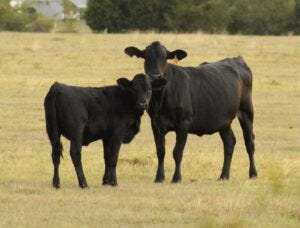
It was late summer, just before I was entering fifth grade. The corn was high, lush, and green. A big cattle truck from the sale barn delivered some newly-bought young Texas Black Angus calves. They were wild and full of energy. They danced in the pasture, excitedly kicking their feet. The green grass and fresh Ohio air stirred their spirits. Their big problem was the confining fence of our small pasture. Two days after their arrival, a frisky calf attempted to jump the pasture fence. The straight wire fence was bent low, leaving an escape route. Luckily, Dad saw the bent fence. He temporarily fixed it, planning a better repair job the next day.
Who knows what happened later that afternoon? Was it a simple accidental push against the fence? Was it another attempted escape that succeeded in knocking over the fence? Something happened that enabled freedom for all the calves.
Most times, with the help of a few neighbors, escaped cattle are easily rounded up. These calves were off and running. Lucky for them, the corn hid their location. Dad’s friend Ron and his son came with their horses. They started making their way through the nearby cornfield. Soon, some calves were rounded up. By the next day, most of them were safely back in the pasture behind a secured fence.
Two weeks later, four calves were still missing. The whole county seemed to be talking about the missing calves. Word reached Glen, a local hobby pilot with a small plane. He contacted Dad and offered to fly over the area. He was sure they could spot the runaways with an aerial view.
Lucky for me, there was room on the plane for an extra passenger. Dad said I could go along. I had never been inside a plane.

There were two seats in front where Dad and Glen sat. I was in the back right next to a small window. The plane’s engine was noisy. The whole passenger compartment smelled of fuel. None of that stopped my excitement.
Everything looked different from the air.
“The cars look like tiny toys! The barns are so small!”
“It’s a pretty amazing view,” Glen responded.
“There’s deer.”
“Keep your eyes open for calves,” Dad added.
We hadn’t been flying long before Dad shouted, “There, in that cornfield.”
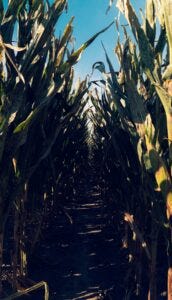
They were hard to see. You had to carefully watch. The corn provided the perfect cover. The young calves blended in with the dark spaces between the rows. Glen flew lower. We could just make out the well-hidden Black Angus calves. The four of them had stayed together. We were 15 miles from home.
Dad contacted Ron. He and his horse along with a crew of neighbors arrived that afternoon. They managed to surround the cattle and move them out of the cornfield. They carefully herded them onto a truck. Once loaded, they were brought safely home. The cattle returned well-fed, thanks to a stranger’s cornfield.
I loved flying in Glen’s small loud plane. The fresh view was exciting. I felt powerful as we soared high above the world. There was excitement in searching and finding.
I discovered how different things look when viewed from an unfamiliar place. With a different perspective, I saw things I wasn’t looking for and missed what I had set out to find.
I look back on my adventures and travels, I realize how I’ve looked for freedom from unnecessary fences. I see how I’ve searched for Mennonites that I can call my herd. Did I know what I was looking for – or did I find unexpected things I wasn’t searching for?
In today’s world, certain flavors of Mennonites can be hard to spot since the women don’t wear coverings or even the updated head doily. Their clothes and cars look normal. You can fly over the world and never spot a Mennonite – unless you run into one by some chance conversation.
Flying over my past experiences, I see the many interesting Mennonites I’ve spotted, Mennonites of different flavors, Mennonites who provided a fresh view, an unexpected image, and sometimes an unsettling perspective. They inspired me to see the world differently.
How did I end up in Pennsylvania? A Mennonite high school was asking for an art teacher. One of my art professors encouraged me to apply. They had never offered art. Art was a little suspect, a little too frivolous.

I headed to C. Norman Kraus’s office, my trusted bible prof, to ask about the school.
“What should I do? I won’t fit in.”
“Here’s what I think. Go for the interview. Be honest. Tell them what you think. If they hire you, try it for a year. It might just be good for you. It could be good for them.”
It seemed like reasonable advice.
The interview was all men, in plain cut coats, sitting around a long table in a small room. Certain flavors of Mennonites require men in leadership to wear coats with no lapels and buttoned to the throat. They weren’t about to be conformed to the world. The room smelled of formalities and stiffness.
“Are you sanctified?”
It wasn’t a question I had planned on. “Sorry, I don’t know what sanctified means.”
“Sanctified means you are set apart from the world. You are Holy,” answered the stern man leading the interview.
“Oh, yeah, I’m set apart from the world. The world believes in military might instead of peacemaking. The world believes in accumulating wealth, and I hope to share resources. The world believes style is important and I ignore the latest fashion.”
“You’re not wearing a covering. Would you wear a covering if we require it?”
By now I realized I wasn’t getting the job, so I didn’t care what I said. I had long ago given up my small white net head covering.
“I think coverings are a way to keep women in their place. If you’d require it, I would see it as a school uniform and take it off the minute the school buzzer sounded at the end of the day.”
They kindly thanked me and I returned to the safe Mennonites in Indiana. I was sure they wouldn’t offer me the job. I was sure I didn’t fit inside their fences. I had twisted their ideas of sanctification and insulted the covering. Then – they offered me the job.
I asked C. Norman, “What should I do?”
“It’s your chance to be an ambassador.”
“Right. I don’t think it will work. I’m not sure I want to be an ambassador.”
“I have confidence in your honesty, and more importantly in your compassion.”
Thus, it happened. I was off to teach in a foreign culture. I did love the students. It seemed like the troublemakers and marginalized students found their way to my room. After lunch, they just started wandering in.
“What can I do? Mr. G. hates me.”
“Can you get me out of detention? I could come and clean your chalkboards.”
“Do you think I’m going to hell?”
There were always questions. I tried to use C. Norman’s method and ask them questions back.
“What makes you think Mr. G. hates you?”
“Can you use detention as a time to study?”
“What’s got you thinking about hell?”
It was a hard year. Maybe I’m sorry about some things.
Yes, maybe I’m sorry I didn’t turn in the student who gave me his marijuana. He was under pressure to behave. His family had just become Mennonite, and it was a cultural shock for him. He didn’t need more trouble.
Yes, maybe I’m sorry my sweater was too tight, but you could have discussed tight sweaters in private. You didn’t have to bring them up in a faculty meeting.
Yes, maybe I’m sorry I wore jeans to see a church movie, but the fellow who asked me to go along didn’t tell me the movie was playing at a church and not a theater. How was I supposed to know? And on top of it all, I didn’t appreciate the movie’s use of fear to save people.
Yes, maybe I’m sorry I hugged C. Norman in public after his chapel talk, but I was just so glad to see him.
Ironically, hidden among the Pennsylvania Mennonite terrain, I found Myron Dietz. Dietz taught social studies and church history. He was Old Order River Brethren. This particular flavor of Anabaptists had unsalaried preachers and met in homes. Not only did he wear a plain cut coat, but his branch of Anabaptist required a beard.

We found common ground. We didn’t want to see Mennonites drift into worldly evangelicalism and nationalism. He lived with an aura of simplicity and generosity. I liked to get him talking about how the world was influencing Mennonites.
“Are Mennonites becoming too flavored by evangelicals?”
“What are you worried about, Jane? Mennonites joining the military? Mennonites using fear to save people? Mennonites becoming too proud of being Americans?”
“Maybe all of those.”
“Just keep asking questions. Questions keep us thinking.”
“And like you always tell the students, ‘Don’t ever let your education interfere with your learning.’”
Dietz saw beyond our differences. He didn’t have to agree with me to discuss faith and life. He wasn’t about to let differences limit conversations.
One year in Pennsylvania was enough. I headed back to Indiana.
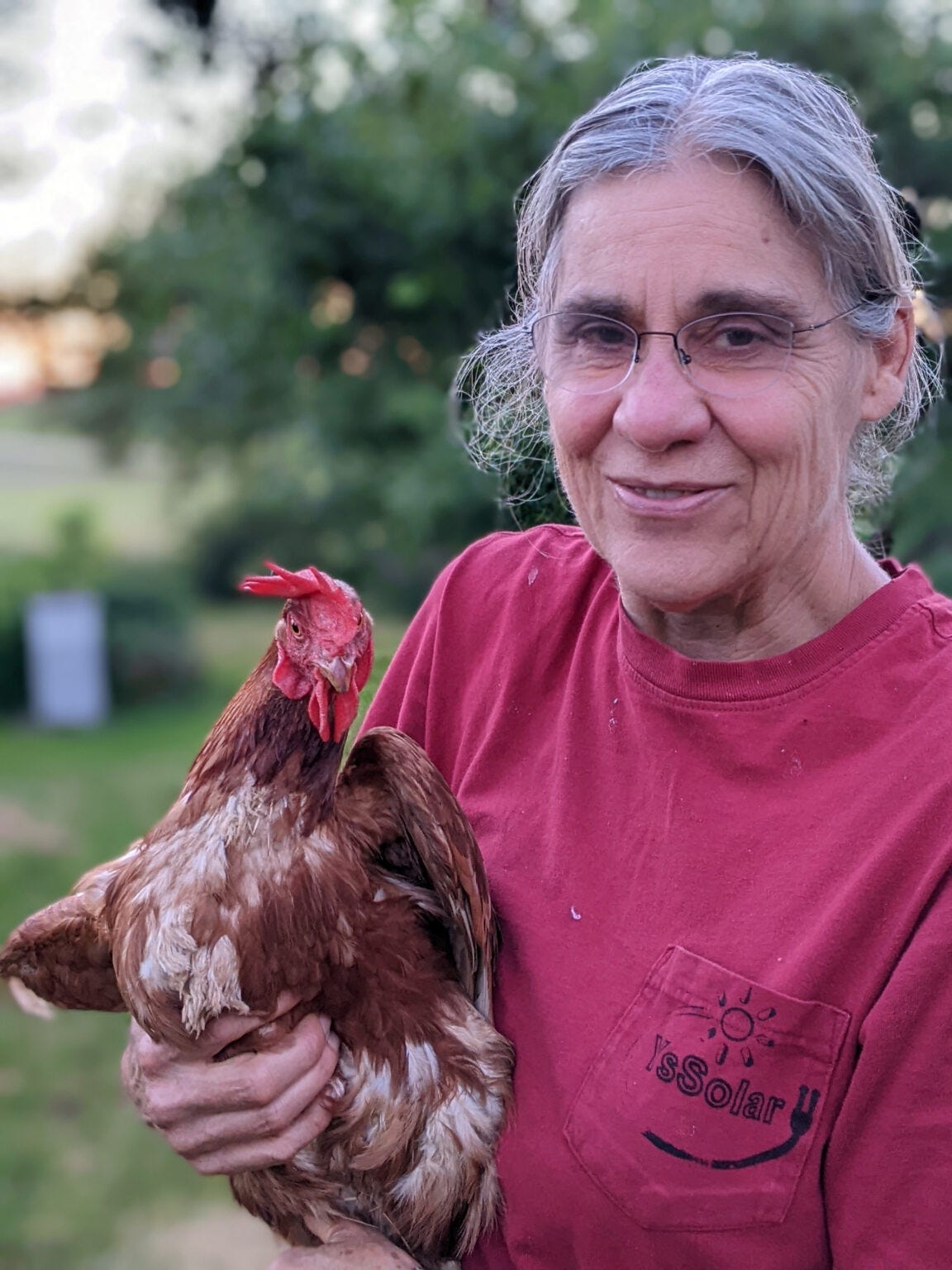
Jane Yoder-Short grew up on a small Ohio farm surrounded by a Mennonite community.
Yoder-Short holds a bachelor’s degree in art and math from Goshen College (Indiana). She holds a professional bachelor’s in architecture from the University of Notre Dame, South Bend, and a master’s in theology and ethics from Anabaptist Mennonite Biblical Seminary, Elkhart.
Yoder-Short joined the Iowa City Press Citizen Writers Group in 2000 and continues to write occasional columns for them. She was a columnist for Mennonite World Review, an Anabaptist publication, from 2010-2020.
Mary Swander’s Emerging Voices is pleased to be part of the Iowa Writers Collaborative. Read and support this talented group here:

Anxiously awaiting the publication of Jane's memoir! "Seeing Beyond Fences" is essential for all at this moment! Thank you, Jane and Mary!
Wow, can I identify with her experience on the farm with broken fences and the cows getting out. But more than that, I certainly experienced the dress code for women as a way of keeping women in their “place”.
She someone I’d love to meet!!